
Skip to content
Fzt. Kemran HafızFizyoterapi & Rehabilitasyon

Herniated Disc (Lower Back) Treatment

A herniated disc occurs when the disc between two vertebrae shifts and presses on a nerve root; for most people it shows up as back pain, pain travelling down the leg, or numbness. Fzt. Kemran Hafız approaches lumbar disc herniation in Bursa Nilüfer by first assessing where the pain actually comes from, then building an exercise programme around that finding.

About your physiotherapist

  • 5.0 · 21 Google reviews
  • Physiotherapy and Rehabilitation graduate, Karabük University (2020)
  • Clinical experience at Romatem Physical Therapy and Rehabilitation Hospital and Karabük Training and Research Hospital
  • One-to-one rehabilitation in Bursa Nilüfer since 2021
  • Education and experience
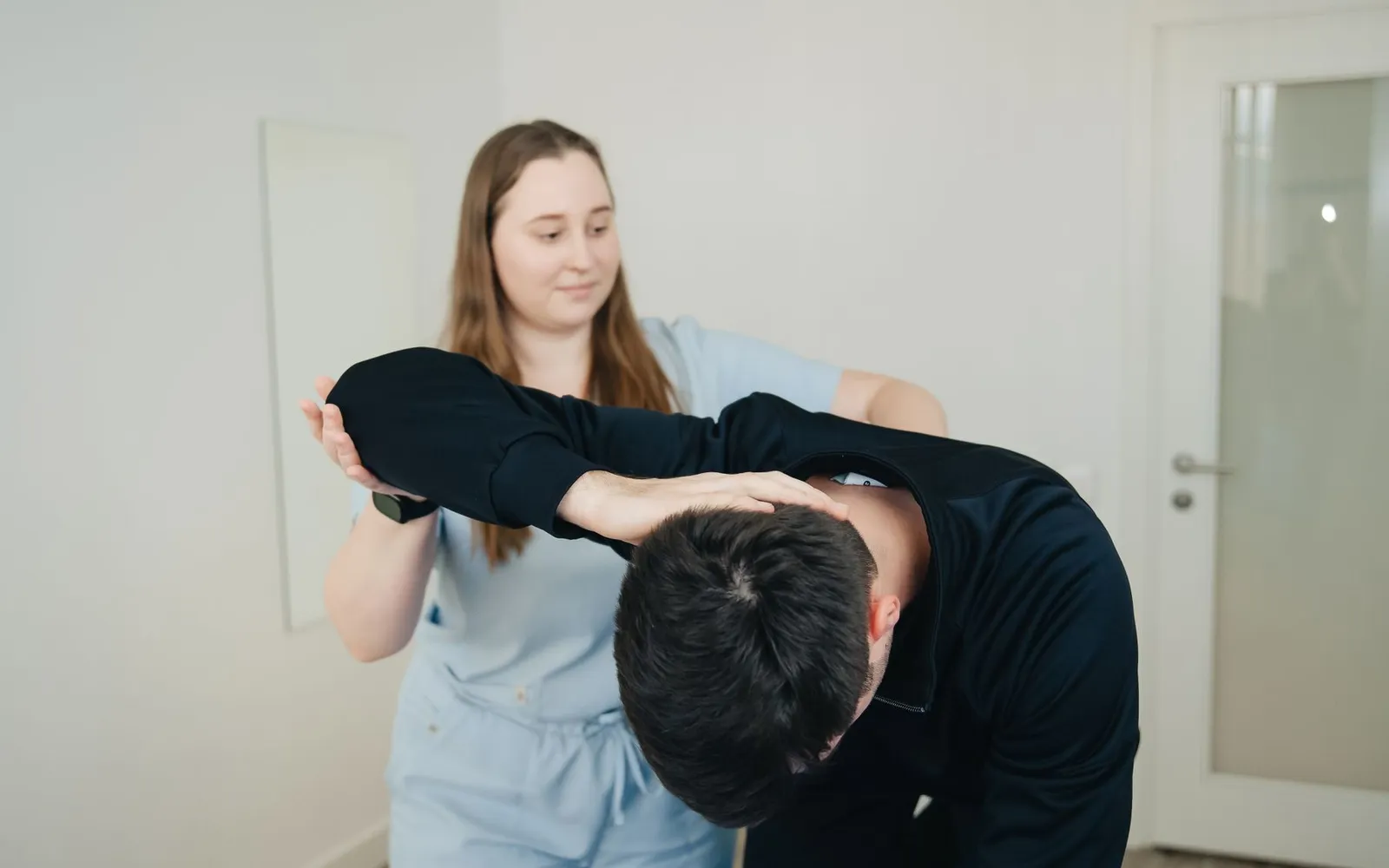
Exercise and manual therapy applied to the lower back

When is it needed?

  • Pain settling in the lower back and spreading down the back of the leg
  • Difficulty lifting the ankle upward
  • Weakness felt when pushing off with the big toe
  • Patchy numbness in the leg or foot
  • A reduced ankle or knee reflex found on examination
  • Walking distance that keeps getting shorter

What we do

  • Neurological examination covering muscle strength, reflexes and a sensory map
  • Identifying which nerve root (L4, L5 or S1) is affected
  • Neural mobilisation exercises that gently glide the nerve
  • A core stabilisation programme built around measurable goals
  • Gait pattern and balance retraining
  • Neurological re-assessment repeated at regular intervals

Herniated Disc in Bursa Nilüfer

Fzt. Kemran Hafız provides one-to-one care for herniated disc at the clinic in Bursa Nilüfer — in Fethiye Mahallesi, on Kelebek Sokak, at a central point of Nilüfer, opposite the Fethiye covered market.

It is a short trip by car or public transport from İhsaniye, Odunluk, Balat, Özlüce, Ataevler, 23 Nisan and the surrounding areas. Every session is one-to-one, assessment-based and tailored to you.

If your leg is numb or has lost strength

Pain shooting into the lower back settles for most people within a few weeks. What actually needs attention is something else: numbness in the foot, difficulty pushing off the big toe, weakness when lifting the ankle upward. These point to the disc pressing on a nerve root, and they change the whole direction of the programme.

Fzt. Kemran Hafız starts the assessment with muscle strength and reflex testing to identify which nerve root is affected. When a nerve sign is present, the goal is not limited to reducing pain — regaining lost strength and rebuilding safe walking are equally important. If a finding is progressing, a physician review is arranged; where physiotherapy's role ends is clear from the start.

Which nerve root is affected?

In a herniated disc, symptoms follow a different pattern depending on which nerve root is compressed. When the L4 root is affected, numbness appears on the front-inner thigh along with weakness in knee extension. The L5 root typically shows numbness on the top of the foot and big toe, with difficulty lifting the ankle or big toe upward. When the S1 root is involved, numbness on the outer edge and sole of the foot, a reduced ankle reflex, and difficulty pushing off the toes stand out.

This distinction is made by examination, not by guesswork. Knowing which root is affected determines both which muscle the programme focuses on and how progress will be measured.

Surgery or physiotherapy?

Most herniated discs with a nerve sign are also managed without surgery; what decides the path is not whether a sign is present but whether it is progressing. The table below summarises this distinction.

AspectPhysiotherapy (non-surgical)Surgery
Who it is forA stable or slowly improving neurological signRapidly progressing weakness, signs of cauda equina syndrome
GoalRestore lost strength and safe walkingSurgically relieve pressure on the nerve
Follow-upProgress tracked with regular neurological re-assessmentSurgery followed by rehabilitation again
Who decidesPlanned together with physiotherapy and neurology/PMR assessmentNeurosurgeon/spine surgeon or orthopaedic physician
The decision is individual; this table is a general framework.

How is progress measured?

In a herniated disc with a neurological sign, "has the pain reduced" is not a sufficient measure on its own. The three areas below are re-assessed at regular intervals, and the programme continues based on them.

MeasureWhat is tracked
Muscle strengthAnkle and big-toe lift strength on a 0–5 scale
Walking distanceThe increase in distance walked without pain or discomfort
Reflex and sensationAnkle/knee reflex and the boundary of the numb area

Home programme and follow-up

In cases with a nerve sign, the home programme is built around a balance that does not strain the nerve but also does not stop movement altogether. Exercises are done together in the first sessions and only sent home once performed correctly.

Follow-up frequency is set according to how the signs are progressing; intervals are widened when a sign is stable or improving, and shortened when it is progressing.

When to see a doctor without delay

Loss of bladder or bowel control, numbness in the saddle area (inner thighs and around the perineum), weakness developing in both legs at once, or rapidly progressing weakness on one side all require urgent assessment. If Fzt. Kemran Hafız finds such a sign during assessment, the physician referral is made without delay.

5.0 · 21 Google reviews

Book a one-to-one assessment for herniated disc

Fzt. Kemran Hafız · Bursa Nilüfer. Share your complaint; we plan the process together after the assessment.

Frequently asked questions

Is nerve damage permanent?

In most cases, no. When the pressure is relieved in time and the programme is followed correctly, strength and sensation largely return; the speed of recovery varies by person and by how long the pressure lasted.

Does a lost reflex come back?

A lost reflex can remain permanent in some cases and is not concerning on its own; what matters is regaining muscle strength and daily function.

I can't lift my ankle — how urgent is that?

A newly started or rapidly progressing weakness should be assessed without delay. A mild weakness that has been stable for a long time can start with a physiotherapy assessment.

What does the neurological exam show?

It shows which nerve root is affected, the degree of strength loss, and the state of the reflexes. This information determines which muscle and which goal the programme focuses on.

Why does my walking distance matter as a measure?

As nerve pressure increases, fatigue and pain in the leg begin at a shorter distance during walking. An increase in that distance is a concrete, measurable sign of improvement.

Further reading

Independent, authoritative health sources. For information only; not a substitute for medical advice.

Other treatments

  • Sciatica

    For pain travelling from the back into the hip and leg: assessment that identifies the source, then graded exercise.

  • Low Back Pain

    For back pain that persists without a clear imaging finding: a programme that looks for the source.

  • Manual Therapy

    Hands-on techniques applied to joints and soft tissue, combined with exercise for a result that lasts.

Articles on this topic

Book an appointment for Herniated Disc

The appointment form does not ask for health information; details are discussed by phone.

Book an appointment